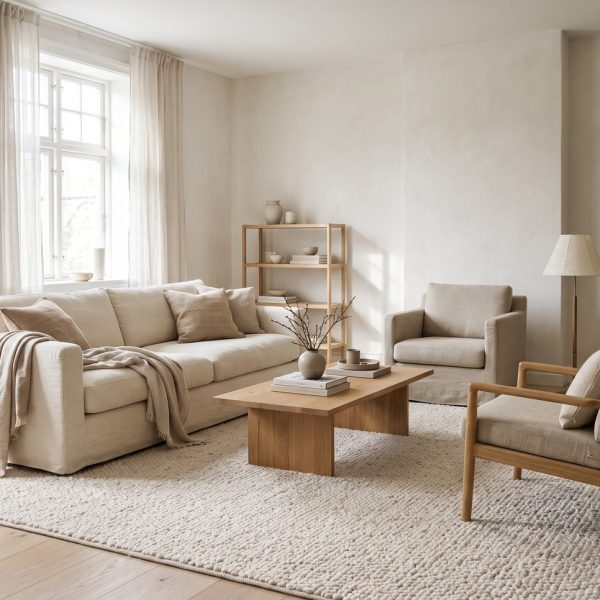
Walk into almost any living room that feels slightly off and there is a good chance the rug is to blame. It floats in the middle of the floor like a postage stamp, or it crowds the walls and makes the sofa look squeezed. Getting the answer to what size rug for living room use is less about taste than about a few simple proportions, and once you know them, the decision takes about ten minutes with a tape measure.
Start with the room, not the rug
Before you browse a single catalogue, measure the seating area you want the rug to anchor. In most homes this means the sofa, the armchairs and the coffee table, not the whole floor. Mark the footprint with painter's tape and step back. The rug should look like it belongs to the furniture group, which is why designers talk about the living room rug size as a relationship rather than a number.
Leave a border of bare floor around the rug, ideally between eight and eighteen inches in a typical room. That strip of floor frames the rug and stops the room from feeling carpeted by accident. In a very small space you can shrink the border to a few inches, but avoid pushing the rug right up to the skirting boards unless you really are covering the full floor.
The three layouts that work almost every time
There are three reliable ways to place furniture on a rug, and choosing between them narrows your options quickly.
The first is all legs on. Every piece of furniture sits fully on the rug, which looks generous and settled. It needs a large rug, commonly 9 by 12 feet in a medium living room, and it suits open plans where the seating group floats away from the walls.
The second is front legs on. The front feet of the sofa and chairs rest on the rug while the back legs stay on the floor. This is the most forgiving approach and the one I recommend to most readers. An 8 by 10 foot rug usually does the job, and it ties the group together without demanding a huge investment.
The third is all legs off, where the rug sits only in front of the seating, under the coffee table. It can work in small rooms, but the rug has to be big enough that it does not look like a doormat. Anything smaller than 5 by 8 feet tends to disappear.
A quick guide to rug size for living room layouts
If you want numbers to take shopping, these are reliable starting points. A compact living room of about 10 by 12 feet pairs well with a 5 by 8 or 6 by 9 foot rug. A mid-sized room of about 12 by 15 feet suits 8 by 10 feet. A large or open-plan space of 15 by 20 feet or more can carry 9 by 12 or even 10 by 14 feet. These are guidelines, not laws, and a long narrow room might call for a runner-style rectangle that follows its shape.
When two sizes seem equally right, go larger. A rug that is a little too big rarely looks wrong, while one that is a little too small almost always does. Larger rugs also make a room read as bigger, which is a quiet bonus in compact homes.
How to choose a rug that suits how you live
Size is only the first filter. If you have children, pets or a lot of foot traffic, look for low pile, flat weaves or performance fibres that hide stains and vacuum easily. Wool is resilient and naturally springy, while synthetic blends are budget friendly and often easier to clean. The long history of the carpet as a woven craft explains why wool still sets the benchmark for durability.
Colour and pattern deserve a thought too. A patterned rug hides wear and gives a plain sofa some personality, while a solid neutral lets bold furniture take centre stage. If you love a richer look, layering a smaller rug over a larger natural-fibre one adds depth without much cost, and this approach pairs nicely with the ideas in this guide to bold, layered interiors.
Don't forget the pad and the practical details
A good rug pad is not optional. It stops slipping, protects the floor and adds cushioning that makes a thin rug feel luxurious. Cut it about an inch smaller than the rug on every side so it stays hidden. Check door clearance as well: a thick rug can catch the bottom of an inward-opening door, so measure before you commit.
Many people who ask these questions are in the middle of a move and furnishing a place from scratch, sometimes abroad. If that is you, the practical advice in what to know when facing a job relocation is a useful companion for the paperwork side of settling in. And if you want to see how other readers solve awkward layouts, the community at r/InteriorDesign is full of before and after photos worth browsing.
The short version
Measure the seating group, pick a layout (front legs on is the safest), choose the largest rug that leaves a clear border of floor, and add a pad. Do those four things and the rug will quietly pull the whole room together instead of fighting it.
Guides like this one also matter on the other side of the counter. Local furniture shops, carpet fitters and interior stylists win much of their work from people furnishing a home in the same town, and those customers almost always search locally first. Shops that use local seo services appear at the top of those searches, so their advice and their stock are what local buyers find. For a small interiors business, that visibility is the difference between a busy showroom and a quiet one.